
Written by Jeff Chandler, South Carolina Attorney
Practicing in South Carolina since 1999
Last reviewed: January 2, 2026
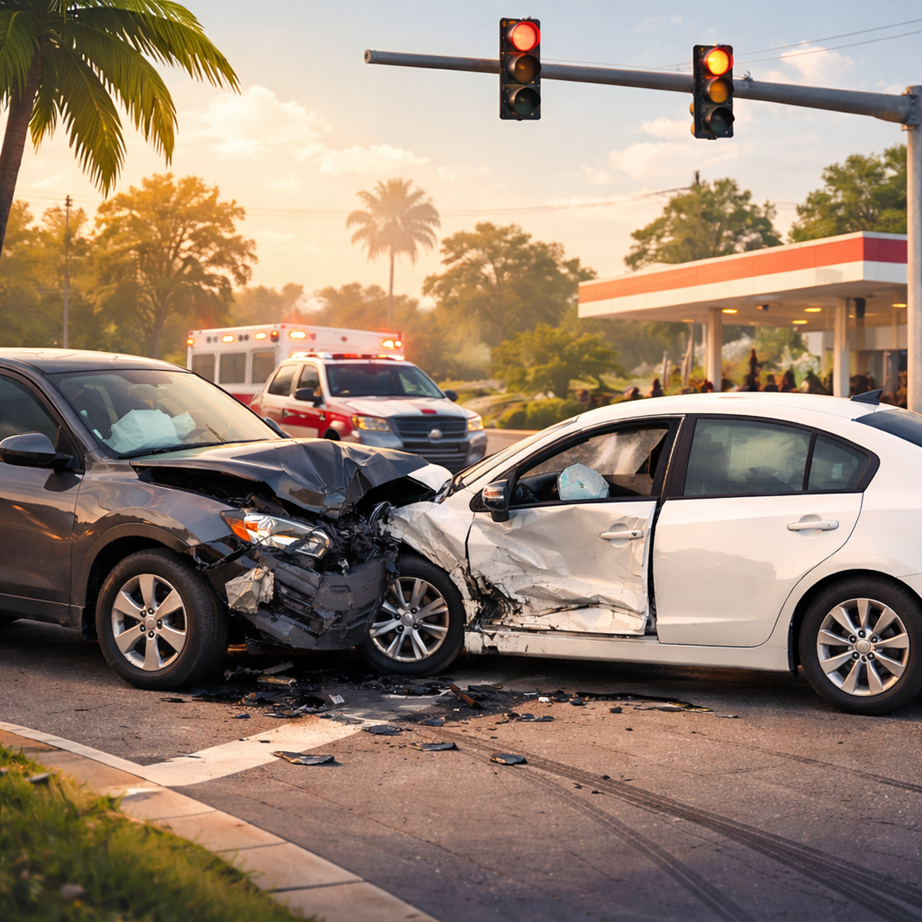
A T-bone (side-impact) collision happens when the front of one vehicle strikes the side of another—most often in an intersection.
These crashes are common in South Carolina because intersections combine multiple decision points, including signals, stop signs, left turns, lane changes, and pedestrian crossings.
They also create immediate disputes about who had the right-of-way.
Below is a practical, South Carolina-specific guide to proving liability after an intersection T-bone accident, including the key statutes that often decide fault and the types of evidence that can make or break a claim.
You might find our step-by-step car accident checklist useful, too!
Why intersection T-bone crashes are so hard-fought
Compared with rear-end collisions, T-bone cases are less “automatic.” Drivers frequently disagree about:
- whether a light was green or red
- whether someone rolled a stop sign
- whether a left-turning driver misjudged distance/speed
- whether a view was obstructed
- whether the “favored” driver was speeding or distracted
Because side-impact crashes can cause severe injuries (head/neck trauma, chest injuries, and fractures), insurers tend to scrutinize liability early—and aggressively.
The building blocks of liability in South Carolina
Most intersection T-bone cases are negligence claims.
In plain terms, you generally must prove: (1) duty, (2) breach, (3) causation, and (4) damages.
At intersections, “duty” and “breach” usually come from South Carolina’s right-of-way and traffic-control statutes.
Importantly, South Carolina courts recognize that a causative violation of a safety statute can support negligence per se—meaning the statute helps establish the breach element when the violation causes the crash.
Key South Carolina intersection laws that often decide fault
Left turns: the turning driver usually has the burden
One of the most common T-bone scenarios is a driver turning left across oncoming traffic.
South Carolina law requires a left-turning driver in an intersection to yield the right-of-way to oncoming vehicles that are in the intersection or close enough to be an immediate hazard. South Carolina Legislature Online
You can review the statute in the official South Carolina Code here: S.C. Code § 56-5-2320 (left turns and yielding). South Carolina Legislature Online
Stop signs: full stop + yield before entering
Stop-sign T-bones often come down to whether the at-fault driver stopped where the law requires and yielded before entering the intersection.
South Carolina’s stop-sign rule requires a driver to stop at the stop line/crosswalk (or, if none, at the point with a view of approaching traffic) and then yield to vehicles in the intersection or approaching closely enough to be an immediate hazard. South Carolina Judicial Branch+1
Official code link: S.C. Code § 56-5-2330 (stop and yield rules). South Carolina Judicial Branch
South Carolina appellate opinions also emphasize the “unfavored road” duty: if your view is obstructed, taking a chance and pulling out can still be negligent. South Carolina Judicial Branch
Red lights: what “steady red” requires
Red-light T-bones are often “he said/she said” unless there’s video, witnesses, or data.
South Carolina’s traffic-signal rules generally require drivers facing a steady red indication to stop, and they address when right-on-red (or limited left-on-red) may be permitted after stopping and yielding. South Carolina Legislature Online
Official code link (traffic-control signals): S.C. Code § 56-5-970 (traffic-control signals). South Carolina Legislature Online
Failure to signal or unsafe lane movement
Some intersection T-bones happen when a driver makes an abrupt turn or lateral movement without proper signaling.
South Carolina law generally prohibits turning or moving right/left unless it can be done with reasonable safety and requires an appropriate signal (typically for at least the last 100 feet before turning when required). South Carolina Legislature Online
Official code link: S.C. Code § 56-5-2150 (turning movements and required signals). South Carolina Legislature Online
Evidence that helps prove liability in a T-bone accident
Because intersections produce conflicting stories, the winning liability case is usually the one with the best proof, not the loudest argument.
1) Independent witnesses (and fast follow-up)
Neutral witnesses can be decisive—especially for red-light and stop-sign disputes. Get names/numbers at the scene if possible, and preserve written or recorded statements early while memories are fresh.
2) Video: traffic cameras, business cameras, dash cams
Many intersections have nearby businesses, gas stations, or municipal cameras. Video is often overwritten quickly (sometimes in days).
A prompt request for the video can matter.
3) Vehicle damage patterns and crash reconstruction
Damage location can support right-of-way arguments.
For example, a clean “front-to-door” impact may support that the struck vehicle was already established in the lane of travel, while an angled impact may suggest the struck vehicle was still entering/turning.
Skid marks, gouge marks, and debris fields can help reconstruct speed and point of impact.
4) Electronic data: “black box” and phone evidence
Many vehicles store event data (speed, braking, throttle) around a collision.
Cell phone records can also become relevant when a distraction is alleged. These issues typically require formal legal steps to obtain and preserve.
5) Intersection conditions and visibility
Sometimes liability is more complex than Driver A vs. Driver B—think blocked sight lines, malfunctioning signals, confusing signage, or construction control issues.
In those cases, it’s important to identify all potentially responsible parties early and preserve photos and measurements of the scene.
What if both drivers share fault? South Carolina comparative negligence
South Carolina uses a modified comparative negligence rule.
In a South Carolina Supreme Court opinion discussing the rule from Nelson v. Concrete Supply Co., the Court explained that a plaintiff “may recover damages if… negligence is not greater than that of the defendant,” with damages reduced by the plaintiff’s percentage of fault. South Carolina Judicial Branch
In intersection T-bone cases, insurers often argue shared fault—for example, “you had the green light, but you were speeding,” or “you had the right-of-way, but you weren’t keeping a proper lookout.” Evidence (video, EDR data, witnesses) is how you push back.
Deadlines: don’t ignore the clock
Most personal injury claims must be filed within three years under South Carolina’s general limitations statute (commonly applied to “injury to the person”).
South Carolina also has a discovery rule provision for certain actions that can affect when the three-year period begins to run.
Official code link: S.C. Code § 15-3-530 (three-year limitations categories). South Carolina Legislature Online
Get Answers Fast After a South Carolina T-Bone Crash—Protect Evidence and Your Claim Before It’s Gone
If you or a family member was hurt in a South Carolina intersection T-bone crash, liability can turn on details that disappear fast—video overwrites, vehicles get repaired, and witnesses move on.
A car accident lawyer in Myrtle Beach can help preserve evidence, identify the right-of-way rules that apply, and evaluate comparative fault issues that may affect recovery.
About the Author
 Jeff Chandler has practiced law in South Carolina since 1999. His practice includes workers’ compensation, personal injury, and medical malpractice matters. He represents injured individuals throughout South Carolina from Chandler Law Firm's Myrtle Beach and Charleston offices.
South Carolina Bar Admission: 1999
View Jeff Chandler's Attorney Profile →
Important Legal Information
This page provides general information about South Carolina law and is not intended as legal advice. Reading this page or contacting Chandler Law Firm does not by itself create an attorney-client relationship. The application of the law depends on the facts and circumstances of each case.