
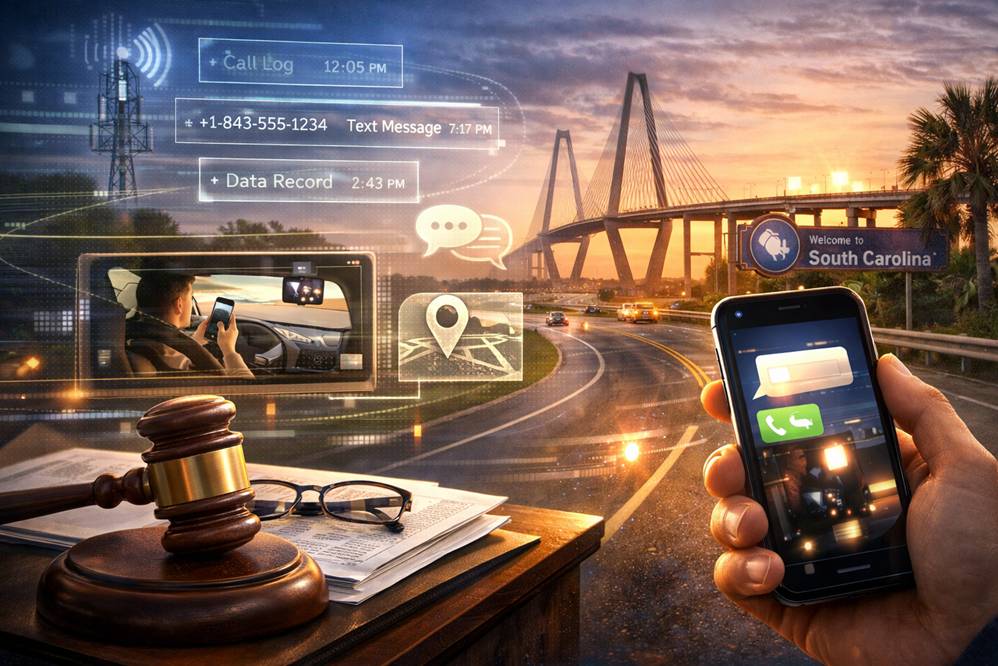
Distracted driving car crashes can feel uniquely frustrating because the harm often comes from an entirely preventable decision—checking a notification, scrolling a playlist, or holding a phone during a call.
The hard part for many injured people isn’t understanding what happened; it’s proving it.
That’s where phone records and other digital evidence can matter.
In the right case, they can help show what a driver was doing in the minutes (or seconds) leading up to impact, support witness accounts, and counter the “I wasn’t on my phone” defense.
Below is a practical overview of South Carolina’s distracted driving rules and how phone records and related evidence are commonly used by personal injury lawyers in claims.
South Carolina’s distracted driving law and why it matters in a crash case
South Carolina’s current hands-free law is found in South Carolina Code § 56-5-3890.
It generally prohibits holding or supporting a “mobile electronic device” while driving and also prohibits reading, typing, transmitting text-based communications, or watching video content while operating a vehicle on a public highway. (South Carolina Legislature Online)
The statute also lists important exceptions—such as being lawfully parked or stopped, contacting public safety in an emergency, and certain limited device interactions for navigation or audio when the device is not held or supported. (South Carolina Legislature Online)
For crash claims, violations can be relevant because they help frame whether a driver acted unreasonably under the circumstances.
Even when a citation is not issued, the underlying conduct (texting, holding the phone, watching a video) may still be investigated and proven through evidence.
Note: the law’s enforcement limits also matter—§ 56-5-3890 restricts certain law-enforcement actions.
For example, it limits the stopping authority and prohibits seizing/searching a phone solely because of a violation. (South Carolina Legislature Online)
In a civil injury case, evidence is typically gathered through the civil discovery process rather than through a roadside phone search.
What “phone records” can—and cannot—prove
When people say “phone records,” they often mean carrier call detail records (CDRs). These may show:
- Incoming/outgoing calls (numbers, timestamps, duration)
- SMS/MMS activity metadata (timestamps and sometimes direction), depending on carrier and plan
- Data session information in a general sense (not usually which apps were used)
What they often do not show by themselves:
- The content of text messages (the words)
- Social media/app activity details (scrolling, typing, watching videos)
- Whether the driver was actually holding the phone (that may require other evidence)
That’s why the best distracted-driving investigations usually combine multiple sources.
Key evidence sources in distracted driving accident cases
1) Carrier records and tower/location information
Carrier records can help build a timeline—especially if a call or text happened close to the collision time.
In some matters, location-related information may also be requested, but it can raise additional legal and privacy issues depending on what is sought and how it’s pursued.
(Courts treat certain forms of cell-site location information with special sensitivity in other contexts.)
2) The phone itself (device-level evidence)
If the phone can be lawfully preserved and examined, a device may contain:
- Screen-time or “digital wellbeing” logs
- Notification history
- App usage data (when an app was opened)
- Draft texts, deleted items (sometimes recoverable), and timestamps
Because phones can be wiped, damaged, replaced, or auto-delete data, preservation steps early on can be critical.
3) Vehicle data: infotainment logs and event data recorders
Many newer vehicles track data such as speed, braking, steering inputs, and sometimes infotainment interactions.
While this isn’t “phone evidence” by itself, it can corroborate distraction (e.g., no braking) or contradict a driver’s story about reacting normally.
4) Video and third-party digital evidence
Useful sources often include:
- Dashcams and home/business security footage
- Traffic or parking lot cameras
- Ride-share logs (if applicable)
- “Connected vehicle” apps that track trips or driving behavior
5) Witnesses and scene evidence
Don’t underestimate human observations: a witness who saw a driver looking down, a phone in hand, or drifting lanes can pair powerfully with phone metadata and crash reconstruction.
Authenticating texts and digital records in South Carolina
Even strong evidence can be challenged if it can’t be properly authenticated (shown to be what the proponent claims). South Carolina courts apply traditional evidence principles to modern communications.
For example, South Carolina appellate decisions discuss how authentication can be supported by factors such as content, context, and patterns of communication—rather than requiring an impossible “perfect proof” of authorship. (South Carolina Judicial Branch)
Similarly, courts have addressed challenges involving text messages and related phone evidence, including arguments about admissibility and foundation. (South Carolina Judicial Branch)
In practice, authentication may come from:
- A witness who recognizes the number/account and the conversation context
- Carrier affidavits/certifications and testimony about recordkeeping
- Corroborating evidence (timelines, location, other messages, admissions)
Preservation: how to avoid losing the evidence you’ll need
Digital evidence is notoriously easy to lose. Phones break. Devices get replaced. Data gets overwritten. Carriers purge logs. Apps delete messages.
South Carolina case law recognizes that missing evidence can have consequences in litigation.
Courts have discussed spoliation principles and, in appropriate situations, the possibility of adverse inferences when evidence is not preserved. (South Carolina Judicial Branch)
At the same time, South Carolina has rejected a stand-alone tort claim for negligent spoliation of evidence. (South Carolina Judicial Branch)
That combination makes early preservation efforts especially important—because the remedy is often handled inside the case through evidentiary rulings, sanctions, or inferences, not a separate lawsuit.
Common early steps in distracted-driving crash claims include:
- Sending a preservation letter to the at-fault driver and their insurer
- Requesting that vehicles and devices not be altered or destroyed
- Identifying third-party sources (nearby businesses, dashcams) before footage is overwritten
- Using formal discovery tools (and, when needed, court orders) to request carrier documentation
How phone evidence supports common legal theories
Digital evidence can play different roles depending on the facts:
- Negligence: showing distraction close in time to the collision supports breach of duty and causation.
- Comparative fault disputes: a clean digital timeline may rebut attempts to shift blame unfairly.
- Punitive damages (in appropriate cases): extreme facts can matter, but these issues are case-specific and depend on admissible proof, not assumptions.
What to do after a suspected distracted driving crash in SC
If you believe distraction played a role:
- Get medical care and follow-up—health comes first.
- Document what you saw/heard (e.g., “driver had phone in right hand”) while it’s fresh.
- Preserve photos, witness info, and any dashcam footage.
- Act quickly on third-party footage sources—many systems overwrite within days.
- Consider speaking with a lawyer about evidence preservation and lawful ways to request phone and vehicle data.
Talk with a South Carolina lawyer about preserving phone evidence
Distracted driving cases often turn on evidence that can disappear fast.
If you were injured in a South Carolina car crash and believe the other driver was using a phone, a consultation can help you understand the next steps for preservation, the likely evidence sources in your case, and the process for obtaining records through civil discovery.
Contact our office today to schedule a consultation and learn how we can help investigate a distracted driving claim using phone records, vehicle data, and other available evidence.
This article is for general informational purposes and is not legal advice. Every case depends on its specific facts.